In-Region Routing: Keep your data in the US or EU
Cailee Moberg ·
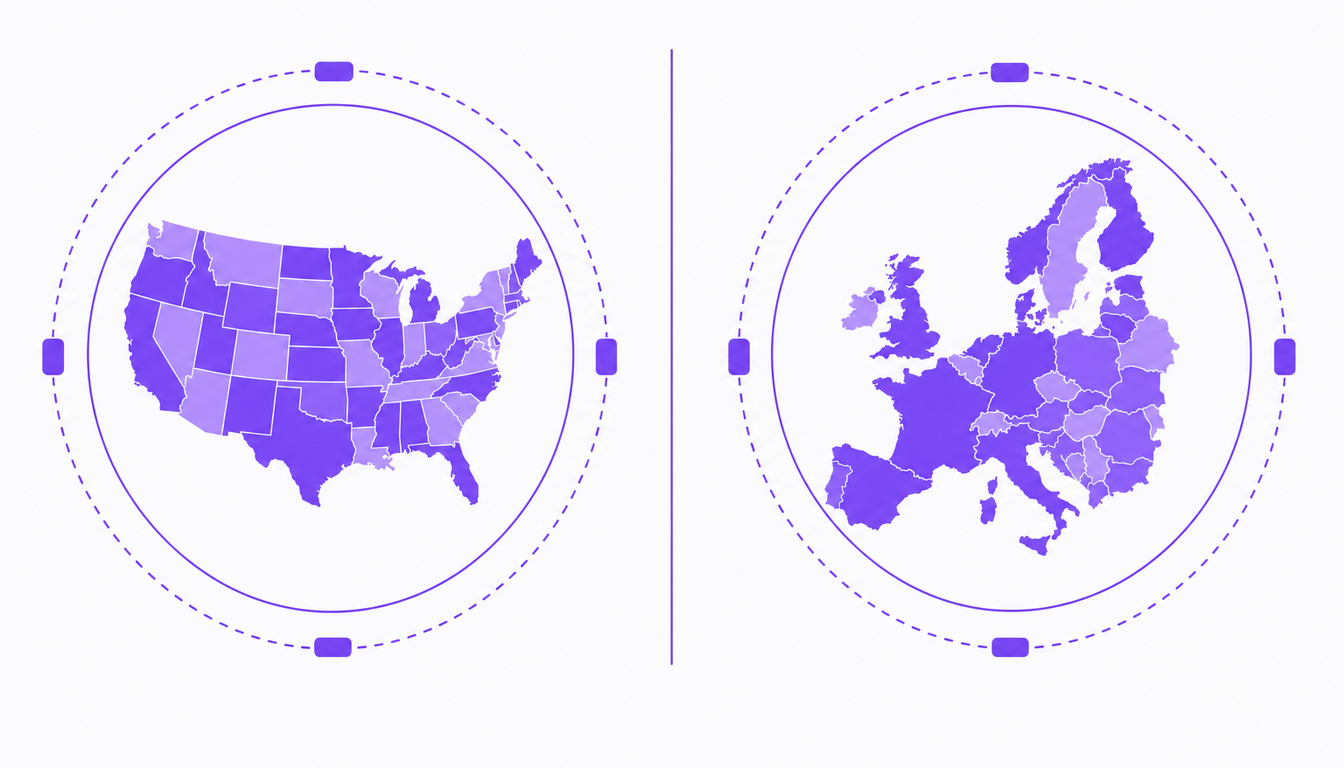
Today we’re launching US In-Region Routing alongside the EU routing we shipped last October, to give you guaranteed control over where your AI workloads are processed. Requests to us.openrouter.ai are decrypted inside the US and routed only to US provider endpoints, so your prompts and completions stay in-region for the entire lifecycle of the request. eu.openrouter.ai does the same for the EU.
Companies need stronger guarantees around data residency and processing. OpenRouter’s In-Region Routing makes it easy to set up for the US or EU.
How it works
Send API requests through the region-specific base URL instead of openrouter.ai:
https://us.openrouter.ai/api/v1
https://eu.openrouter.ai/api/v1
Your API key, request body, and model IDs are unchanged, and your provider preferences, fallbacks, and privacy settings carry over from your account. You can point one service at us.openrouter.ai while the rest of your traffic keeps using openrouter.ai.
Requests sent to us.openrouter.ai or eu.openrouter.ai are decrypted and processed inside that region, and only providers running in that region can serve them. If no in-region provider offers the model, the request fails with a 404 (No endpoints found supporting your data region.) rather than being routed outside the region.
The regional endpoints serve a subset of the global catalog under the same model IDs. A model is listed for a region if at least one provider can serve it from inside that region. For the live list, call /api/v1/models through the regional domain, or filter the models page by In-Region Routing (US or EU). We will continue to add models and providers to both regions. Tell us which models you want in-region next in #feedback on Discord.
You can also enforce In-Region Routing for a specific workspace, team, or API key with Guardrails. Set the guardrail’s allowed data regions to one region, and OpenRouter rejects any covered request that arrives on another hostname. Configure it under Guardrails in your settings or through the Management API.
In-Region Routing is available on the Business and Enterprise plans.
US/EU models served in-region
Without In-Region Routing, using a model from a lab based in the US or EU doesn’t guarantee that a data center in that region serves the request. At global endpoints, models from OpenAI, Anthropic, Google, xAI, Meta, NVIDIA, Thinking Machines, or Mistral can run anywhere the provider serving the request operates. A data residency review asks where your request was decrypted and where inference ran, so a US team using GPT-5.6, Claude Opus 5, or Gemini 3.6 Flash on a global endpoint can still fail a compliance review. OpenRouter In-Region Routing ensures the request stays within the region you specify: US or EU.
Chinese open-weight models available in-region
Open-weight models are improving rapidly, and shifting traffic to them can significantly reduce costs. On OpenRouter, the share of tokens going to open-weight models has risen steadily for requests originating in both the US and EU:
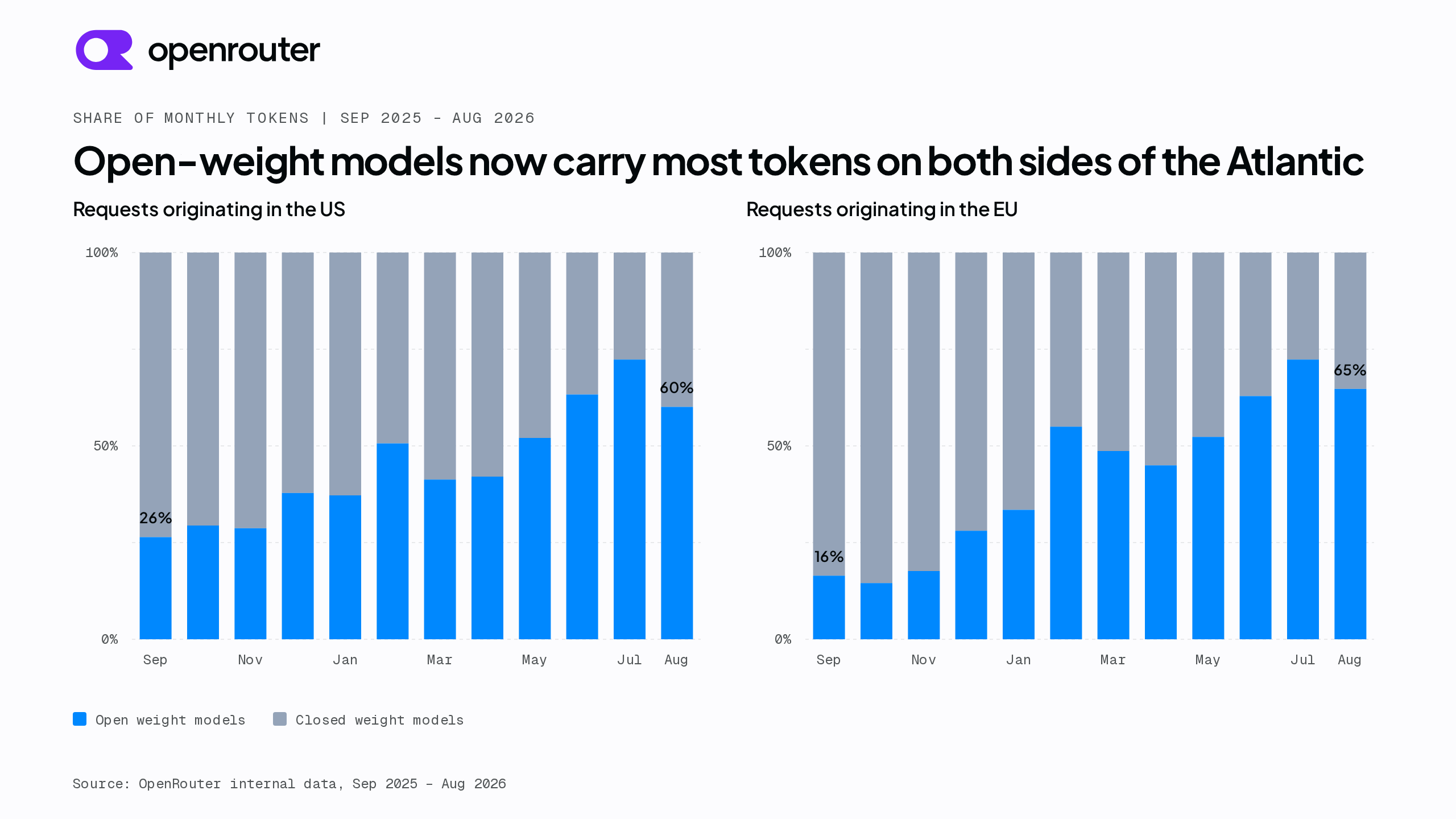
Models from US labs, like NVIDIA’s Nemotron 3 Ultra and Thinking Machines’ Inkling, are part of that growth. But models from Chinese labs are still most of the volume, and procurement approval for those models can be difficult.
In-Region Routing allows teams with data residency requirements to get the price and performance gains from Chinese open-weight models. When a US or EU provider hosts a model, requests go to that provider and the lab is not involved. DeepSeek V4 Pro, Kimi K3, and GLM 5.2 are all available for US In-Region Routing because Baseten, Fireworks, and Azure serve them from US data centers. Send a prompt to any of them through us.openrouter.ai and it is decrypted and run in the US. GLM 5.2 is also available at eu.openrouter.ai, served from Mistral’s EU data centers.
Ensuring end-to-end regional routing
When a gateway offers regional routing, it can mean one of two things. The difference is whether your prompt ever exists in plaintext outside the region.
- Inference-only regional routing. The gateway pins the provider’s inference to your region. But the request itself is decrypted and processed wherever the gateway runs before it is forwarded to the provider. For that part of the path, your prompts are in plaintext outside your region. Server tools are often overlooked for regionalization, which can lead to your prompt data leaving the jurisdiction. For example, web search sometimes uses global instances on regional inference endpoints.
- End-to-end regional routing. This is how OpenRouter’s In-Region Routing works. It keeps your data in-region for the full path. Requests to
us.openrouter.aioreu.openrouter.aiare decrypted inside the region and processed there at every step. Only providers running in that region receive them. If no in-region provider can serve the model, the request fails with a 404 (No endpoints found supporting your data region.) It never leaves the region. We comprehensively evaluate server tools and the data jurisdictions they run in before offering them in a specific jurisdiction. Tools that would send data outside the region are disabled rather than falling back to global infrastructure.
When you evaluate any gateway’s data residency claim, ask two questions. Where is the request decrypted and processed? And where do its tools run?
Get started
In-Region Routing is available on our Business and Enterprise plans. Upgrade to Business from your plan settings, or talk to the enterprise team.
Then pick a model from the US or EU list and send your requests to https://us.openrouter.ai/api/v1 or https://eu.openrouter.ai/api/v1.