How an AI Sales Agent Saved Our Sales Team 600 Hours a Month
Michael Haimowitz ·

Rasp is an AI sales agent built on OpenRouter’s Ori that triages inbound, sends first-touch emails, writes pre-call briefs, drafts notes, and updates the CRM. It runs for OpenRouter’s own 5-person sales team. Given the way the business has grown, “drowning” is an appropriate way to describe those five in 2026.
Over the past few months, Rasp has brought some zen back to these frenzied sellers. It took over most of the paperwork/admin and the team now gets back about 600 hours a month. It gave every rep room for roughly two more calls a day at the same level of preparation. It shortened response times, with many leads now receiving a response in under a minute from initial inquiry. The deal cycle has compressed 34%. And because Ori’s routing layer keeps swapping in cheaper models that hold quality, Rasp does all of this for about $30 a day, down from nearly $800 a day for the agents it replaced.
Key results
- ~600 hours/month back to a 5-person sales team.
- ~2 more calls/day per rep at the same level of preparation.
- Deal cycle 34% faster.
- Close rate 2.6x increase. Pricing changes and market conditions moved in the same window, so not all of this is Rasp.
- ~$30/day all-in, versus nearly $800/day for its predecessors, and still falling as Ori routes to cheaper models automatically.
What Rasp does
- Researches and qualifies every inbound lead, and routes non-sales questions elsewhere.
- Sends first-touch emails, 93% of them on its own.
- Writes a brief before every call.
- Drafts post-call notes from the transcript.
- Fills in most CRM fields after each call.
- Flags edge cases and anything sensitive to a person for approval.
Rasp is not a replacement for great reps. It is a street sweeper, clearing the road of debris and pace-reducing clutter so our salespeople can race faster on clear roads.
Lessons from two earlier sales agents
Rasp is not our first sales agent. Two earlier agents, Ace (for AEs) and Dove (for BDRs), handled inbound leads, routing, and a lot of the same workflow Rasp runs today.
Watching those prior two agents taught us a few key lessons:
- One pipeline for everything. Every kind of task runs through the same flow, with the task type as a parameter. Dove and Ace taught us that when each new task type gets its own code path, the system becomes unwieldy and is more likely to drift.
- A feature flag on everything, off by default. We had shipped things before that could not be cleanly turned off. Now everything can.
- Metrics from day one. You cannot measure impact after the fact if you never logged it. Every number in this post exists because Rasp logged from the start.
- Slack is the interface. The team lives in Slack. A dashboard feels like the right place to store metrics, but they are most often consumed where the work actually happens.
This principle of continued iteration means Rasp is likely not the final state - and that’s okay!
How much time an AI sales agent saves per demo
Each demo got 59 minutes cheaper
Before Rasp, one demo required about 103 minutes of work to execute well. Reps would be researching the company before the call, write up notes during and after the meeting, and update the CRM immediately following (well, we hoped).
With Rasp, that same work takes about 44 minutes.
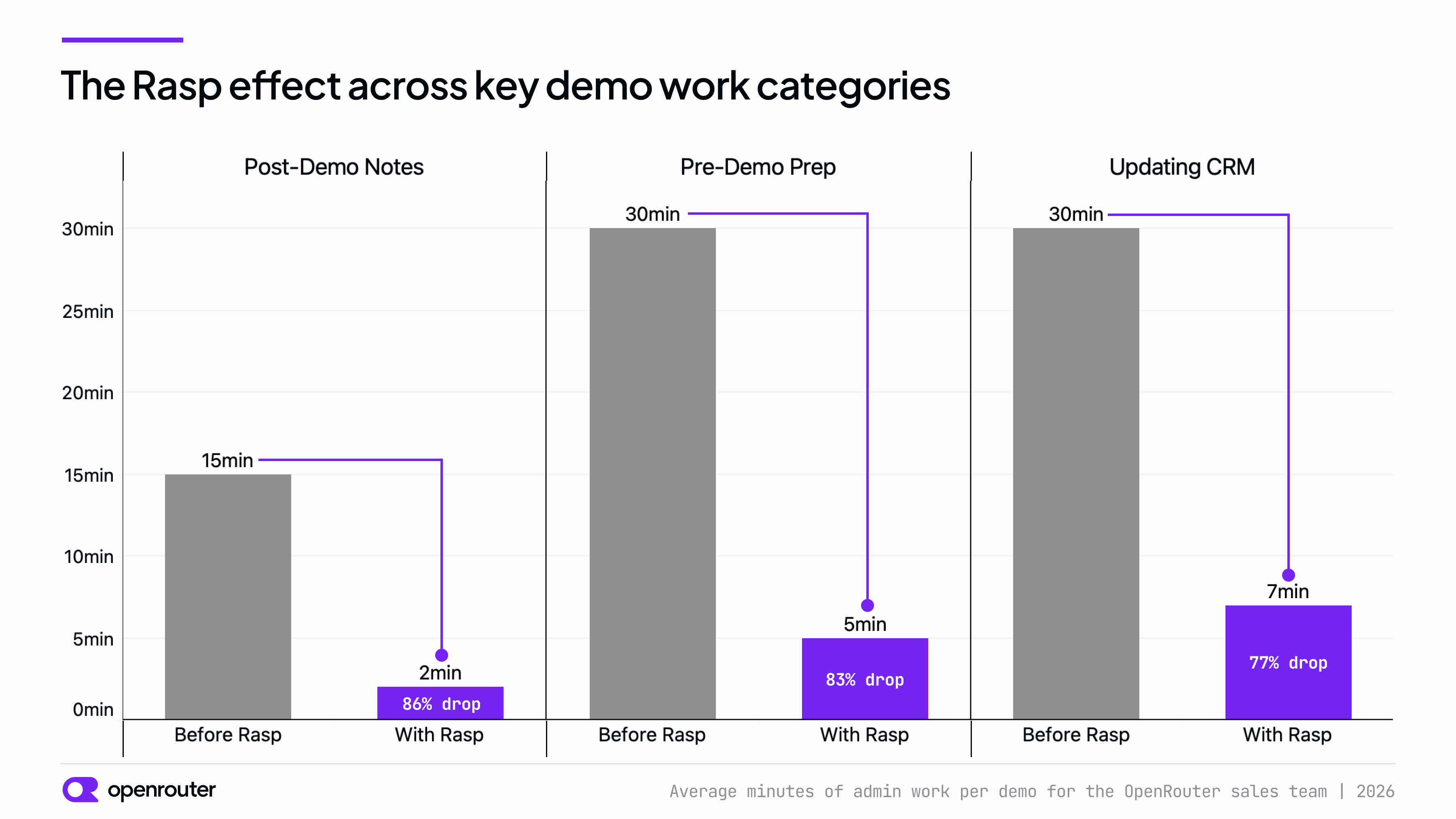
- Pre-demo prep went from 30 minutes to 5. Rasp writes a great brief before every call.
- Post-demo notes went from 15 minutes to 2. Rasp drafts them from the transcript.
- CRM updates went from 30 minutes to 7. Rasp fills in most of the fields, with some room for rep discretion.
Inbound stopped eating a whole person
Before Rasp and Dove, sorting inbound leads and replying to them took the entirety of one rep’s time (and often more than that, depending on the week). This basic resource mismatch led to a necessary consequence: prioritizing only the very best leads.
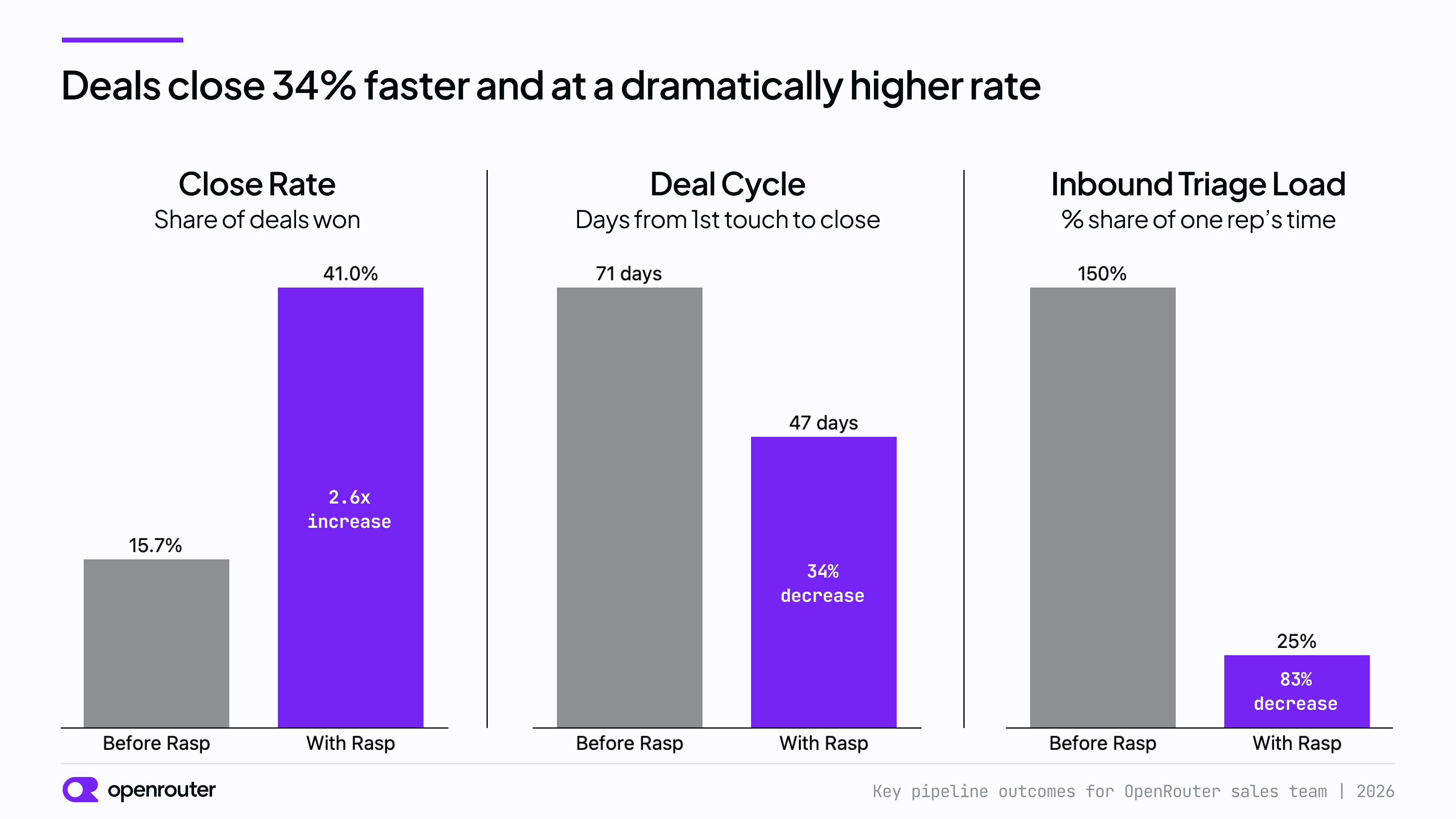
Now that work takes about 25% of one rep’s time. Rasp sends 93% of first-touch emails on its own, and many leads hear back in 60 seconds or less of reaching out to us. The 7% that are sent with human help are the tricky edge cases that Rasp flags to the team proactively.
Adding it up
Across the five-person team, Rasp gives back about 600 hours a month, or roughly 140 hours a week (about 28 hours per account executive). Over a year, that is about 7,200 hours.
What changed for the business
Each rep can take about two more calls a day. Rasp removes roughly an hour of work from every call: about 20 minutes of account research, 15 minutes of notes, 5 minutes of CRM sync, plus the overhead of switching between them. Each AE can add two calls to their day and still show up to each one as prepared and as fresh as before. As one of our reps put it, “the work Rasp takes off my plate is the mundane, always-on drudgery.”
Close rates rose 2.6x over the same period. Pricing changes and market conditions moved in the same window, so we shouldn’t attribute all of the gain to Rasp alone. But the correlation is striking.
Reps show up better prepared. Faster replies are the most visible change, but reps also walk into calls with a brief already written, have more hours for live deals, and work a cleaner pipeline because unqualified inbound is handled without human involvement.
Deals close 34% faster.
Revenue followed. We can attribute about 57% of the current pipeline to capacity the team did not have before.
Cleaner data as a side effect
Before Rasp, inbound was unfiltered and a lot of the time was spent qualifying leads and routing leads to other departments. Personal email domains and support questions landed on the sales team, work was done ad-hoc, and time was spent on frustrating minutia.
Now the intake form filters out personal domains and routes non-sales questions elsewhere. And as Rasp learns across the entire corpus of sales data, lead prioritization is fine-tuned with every new conversation.
What Rasp does not do
Some of the job is still manual because we have more to add to Rasp.
- Follow-ups and re-engaging quiet deals are still done by hand, while dropped-deal detection is under construction.
- Buying roles and use cases now flow into the CRM. Richer deal-context fields are still being debated before getting added to the core taxonomy.
Some of the job is manual by design:
- Running the actual call.
- Deciding when to push and when to pull back in a negotiation.
- Building the relationship.
- Final approval on anything sensitive.
The split is pretty simple - Rasp recommends, drafts, flags, and routes. It never makes the final call on a send, a deal classification, or a compliance question without a person in the loop. Relationships are built person to person and agents themselves don’t build trust.
So… why the name?
A rasp is a coarse file. You use it to shape wood or metal, taking material off and leaving rough texture behind.
It felt like a great name for something that does shaping work on a company pipeline. Rasp drafts, sorts, flags, and routes, whittling down the raw sales material. People step in, polish the woodwork, and complete the piece.
What a GTM agent needs: four requirements
Many companies are building versions of Rasp for sales and GTM teams. Having built three of them, we think an agent like this has to clear four bars.
- Easy to stand up. Rasp is one pipeline with the task type as a parameter, a feature flag on everything, and metrics logged from day one. Adding a new job for Rasp is a simple chat, no engineer needed.
- Slack-native. The team never leaves the tool they already work in. Briefs, drafts, flags, and metrics land where the work happens.
- Impactful. About 600 hours a month back to a five-person team, two more calls a day per rep, and most inbound answered in under a minute.
- Automatically cost-optimizing. This is our differentiator. Agents (or interns) built on Ori from OpenRouter get cheaper over time. Our routing layer underneath the intern will keep searching for a cheaper model that maintains quality and swap it in without the agent or the team lifting a finger.
For example, Ace and Dove, Rasp’s direct predecessors, were approaching $800 a day. Rasp does the same work for about $30. Both figures include engineering time plus the routine outputs the agents produce, so this is an apples-to-apples comparison of what the same scope of work costs us. Of that ~$30, roughly $18 is inference on GLM 5.2; the rest is engineering time.
We validated current pricing on the OpenRouter API for three cheaper models that could take the routine Rasp cost down even further.
Prices as of September 2026.
| Model | Prompt (per 1M tokens) | Completion (per 1M tokens) | Inference cost at ~200 turns/day | vs. GLM 5.2 |
|---|---|---|---|---|
| GLM 5.2 (current) | $1.40 | $4.40 | ~$18/day | — |
| DeepSeek v4 Pro | $0.58 | $1.74 | ~$7.50/day | ~2.4x cheaper |
| GLM 5.3 Flash | $0.08 | $0.25 | ~$1/day | ~18x cheaper |
| DeepSeek v4 Flash | $0.04 | $0.10 | ~$0.50/day | ~37x cheaper |
FAQ
What does an AI sales agent do?
An AI sales agent takes the admin work around selling off the reps’ plate. Rasp researches and qualifies inbound leads, sends first-touch emails, writes pre-call briefs, drafts post-call notes from transcripts, and updates the CRM. Reps run the calls, negotiate, and build the relationships.
How much does an AI sales agent cost per day?
Rasp costs about $30 a day all-in, including engineering time. Roughly $18 of that is inference on GLM 5.2, and moving routine work to cheaper models on OpenRouter could take inference to about $0.50 a day.
How is this different from an AI SDR?
An AI SDR typically focuses on outbound prospecting. Rasp supports the whole sales team across inbound triage, call prep, notes, and CRM updates, and it keeps a person in the loop for final sends, deal classification, and anything sensitive.
If your GTM team could benefit from more capacity, higher close rates, faster deal cycles, and more revenue, join the OpenRouter Ori Intern waitlist today. You’ll wonder how you got by without your own version of Rasp all these quarters.
Sources: OpenRouter validated GTM report, September 2026. Model pricing pulled from the OpenRouter API in September 2026. Ace and Dove cost figures from internal engineering and usage records.