Some families upgrade, others barely move
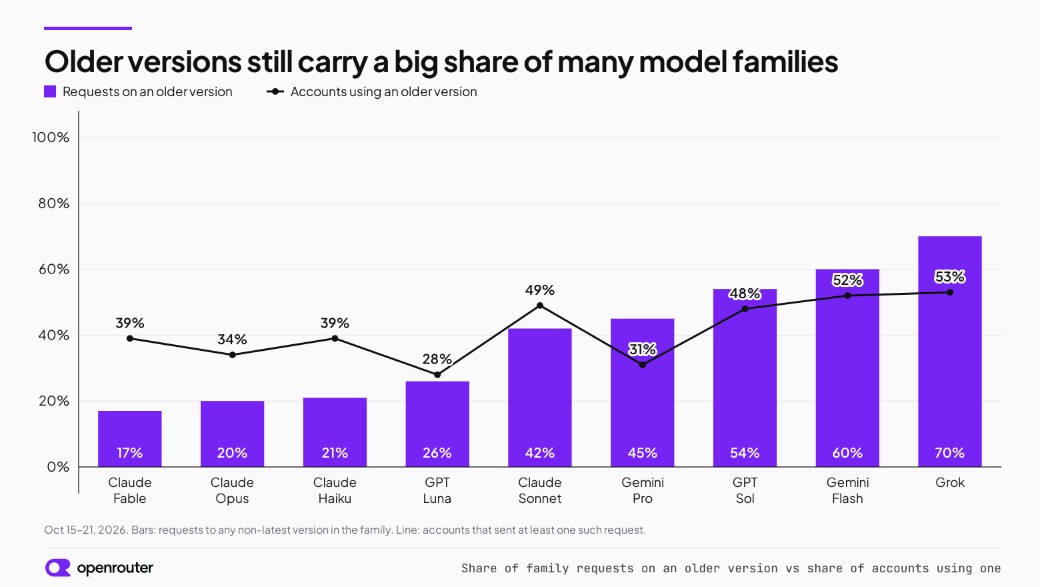
Anthropic customers are the most likely to be using the latest and greatest. Only 17% of Claude Fable requests, 20% of Opus and 21% of Haiku went to an older version last week. Older versions still carried 54% of GPT Sol, 60% of Gemini Flash and 70% of Grok.
These are not trivial traffic figures! Three weeks after Sonnet 5.5 launched, Sonnet 4.6 and 5 still get about 4.5M requests a day.
Intra-family adoption curves vary widely
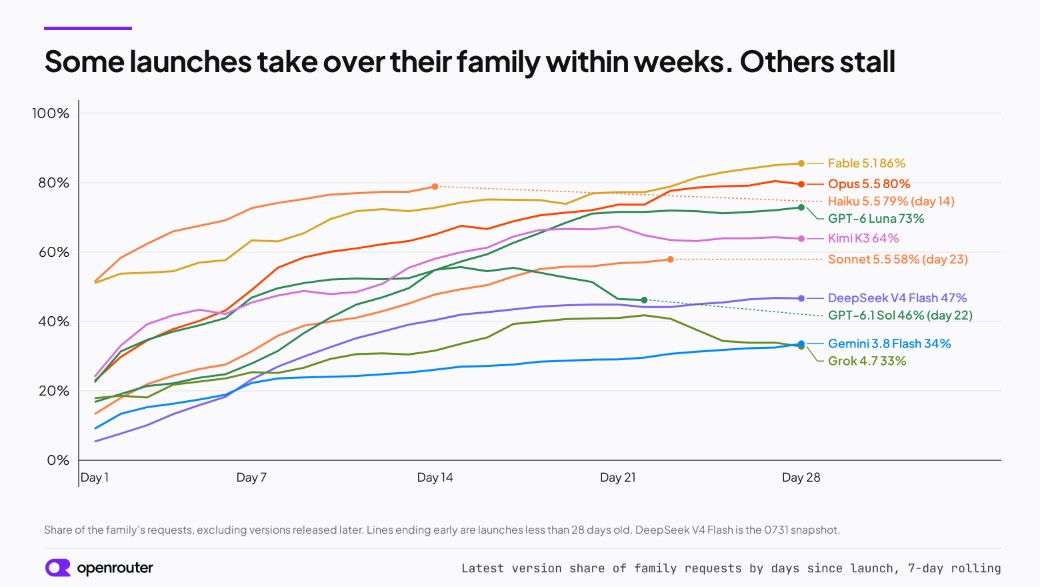
In a prior issue of Inferred, we saw that new models take share quickly within agentic and coding tasks. This coding focus likely accounts for part of the divergence we see in the chart above.
Haiku 5.5 had 73% of Haiku traffic within a week. Fable 5.1 reached 86% after four weeks and Opus 5.5 reached 80%.
Gemini 3.8 Flash, on the other hand, never truly caught on even among users who had been loyal to 3.7 or older models.
It’s clear that price is an obvious lever. Haiku 5.5 is about 90% cheaper than Haiku 4.5 on the same traffic and most workloads were eager to switch. Grok 4.7 costs more than Grok 4.3 and that introduces a switching hurdle. But price isn’t everything: GPT-6.1 Sol is cheaper than GPT-5.6 Sol and still holds less than half its family.
The cost of staying off the newest versions
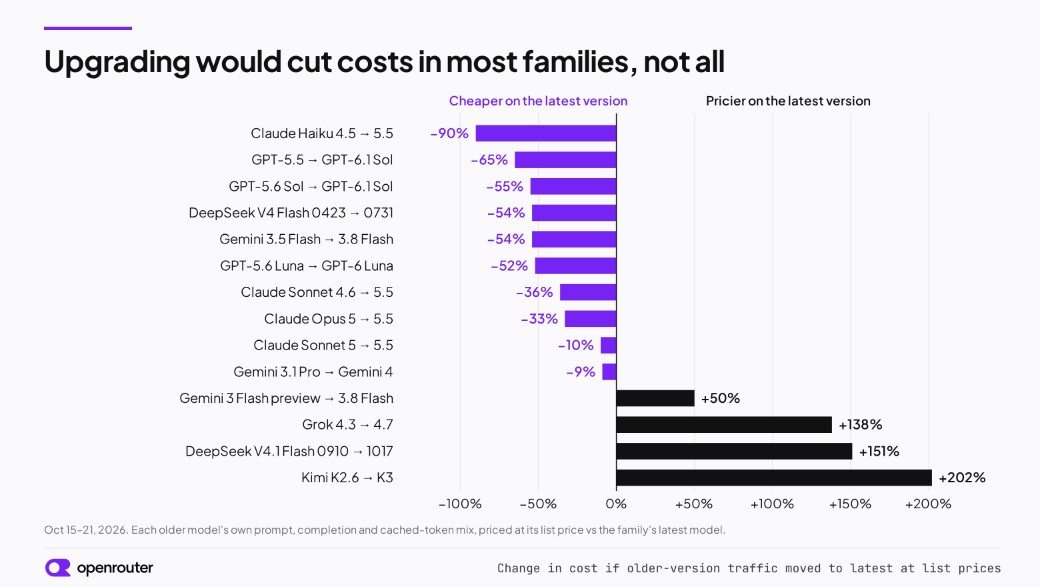
We took last week’s traffic on each older model, with its own mix of prompt, completion and cached tokens, and priced it on the newest model in the family.
For Anthropic and OpenAI, every upgrade is cheaper. Haiku 4.5 traffic would cost 90% less on Haiku 5.5, GPT-5.6 Sol 55% less, Sonnet 4.6 36% less and Opus 5 33% less. In those families, the old model is the expensive one.
Elsewhere, it’s the reverse. Kimi K3 would cost 202% more than K2.6, DeepSeek V4.1 Flash 151% more than 0910, and Grok 4.7 138% more than 4.3. Gemini Flash splits down the middle: 54% cheaper from 3.5 Flash, 50% pricier from 3 Flash Preview.
Dollars really are just lying in the street for many older model users.
Pin models with intent
There are downsides, but pinning a model version isn’t laziness. Evals, prompts and budgets are tuned to a specific model, and every upgrade requires some additional effort to ensure everything is holding well. It’s the same reason translation and support workloads were the stickiest (explored in Issue 04).
But in the frontier families, “we’ll upgrade later” now means paying more for an older model. If you’d rather a family upgrade itself, the latest aliases (like ~anthropic/claude-opus-latest or ~google/gemini-flash-latest) always point to the newest version. Right now users on OpenRouter could save $229,000 a day just by sending traffic through the latest in-family models.
Compare versions, prices, and much more on /models.
Onwards,
Peter
All charts cover October 15 to 21, 2026 (UTC), by request count unless noted. A model family is an OpenRouter version group; “latest” is the newest public model in that group by release date, the same rule the ~latest aliases use. “Older version” is any other model in the group. Only models that belong to a version group can be classified (about 48% of requests), so all-traffic shares are lower bounds. Accounts = unique accounts with at least one request that week. Launch curves show the new version’s share of its family’s requests, excluding versions released later, as a 7-day rolling average. Cost changes price each older model’s observed prompt, completion and cached-token mix at current list prices on the family’s latest model; they are not realized savings, since output length and caching can change after a switch. Concentration check: no single account sends more than 16% of any large older-version model’s requests, except Gemini 3.1 Pro (32%) and pplx-decider 1.1 (31%).