Customer story
Prime Intellect grew 100x on OpenRouter and cut its cost per token by 60%
Prime Intellect builds open frontier models and the stack to train, serve, and improve them. Over the past year its monthly token volume on OpenRouter grew from 11 billion to more than 1 trillion, while its blended cost per token fell about 60%.
Built for intelligence per dollar
Prime Intellect builds open frontier models and the infrastructure to train, deploy, and keep improving them. It’s betting that AI's future is multi-model. “We believe it will be infinite models that continuously self-improve on different use cases,” says Vincent Weisser, CEO and co-founder of Prime Intellect.
“We want to ensure that the future won't be one god model by one company.”
Customers come to Prime Intellect to post-train a model on their own data and serve it on the Prime platform. Before they post-train, they need to know which model to start from. “What a customer wants to see is the model that gives them the most intelligence per dollar,” Vincent says. “And that changes literally every week or month or day, depending on when new models come out.”
Answering that question for customers, and for Prime Intellect's own research, means evaluating new models as soon as they are released. Prime Intellect runs those evals through OpenRouter. It uses the results to choose models on price and performance and send each workload to the cheapest model that can handle it.
More models, more spend, more integrations
“We take evals very seriously. We are constantly evaluating models,” says Will Brown, Head of Applied Research at Prime Intellect. His team tests models it may post-train, or whose outputs it may use as training data, so a new model needs to fit into its existing workflows as soon as it is out.
Stu Cao, who leads Prime Intellect's inference development, gets those requests. “Every day I receive constant requests from the research team: ‘Hey, is this model available? Is this model available?’” he says.
Before OpenRouter, each yes meant connecting another provider's API and setting up another billing plan. Every provider had its own endpoint, API key, authentication and caching controls.
“You are essentially managing tons of different endpoints, also different API keys. And that is a headache.”
Each model’s reliability also depended entirely on the provider the team used to access it. If that provider went down, every request to that model failed, and the team had nowhere else to send it. “You are essentially dealing with a lot of single points of failure,” Stu says.
Spending was climbing at the same time. “We've seen our internal inference spend across our teams go up a lot,” Vincent says.
Why OpenRouter
Prime Intellect wanted to spend engineering time on evaluation harnesses and post-training rather than spending time on the operational complexity of accessing AI models. “It's much easier partnering with you guys than having to integrate thousands of models across hundreds of providers ourselves,” Vincent says.
The team moved its model access to OpenRouter.
“Now it is just one endpoint, one API key. It makes our software stack much cleaner and we focus on the upper stack.”
Will says researchers no longer have to think about where a model is hosted. “I would much rather think about the model, what it can do, how fast it is, how efficient it is, rather than what underlying source it's coming from,” he says. “Being able to just abstract this away is very powerful.”
The results
100x the volume at about 60% lower cost per token
Prime Intellect's monthly tokens on OpenRouter went from 11 billion in November 2025 to more than 1 trillion in September 2026. In that time its blended cost per million tokens fell from about $1.23 to about $0.46.
Vincent credits model choice for much of that, calling it “one of the biggest unlocks now in the sea of hundreds of models.”
“It's really about how can you ensure you always route to the best and cheapest model.”
Provider choice helped too. OpenRouter sends Stu per-model data on traffic, throughput, uptime and providers, and he uses it to tune routing. “OpenRouter actually gave me a super detailed breakdown for each model, what the traffic looks like and what the opportunities to optimize are,” he says. “We take that feedback, for example, set the right provider order. And that actually significantly improved our efficiency, reduced our cost.”
Provider outages no longer reach users
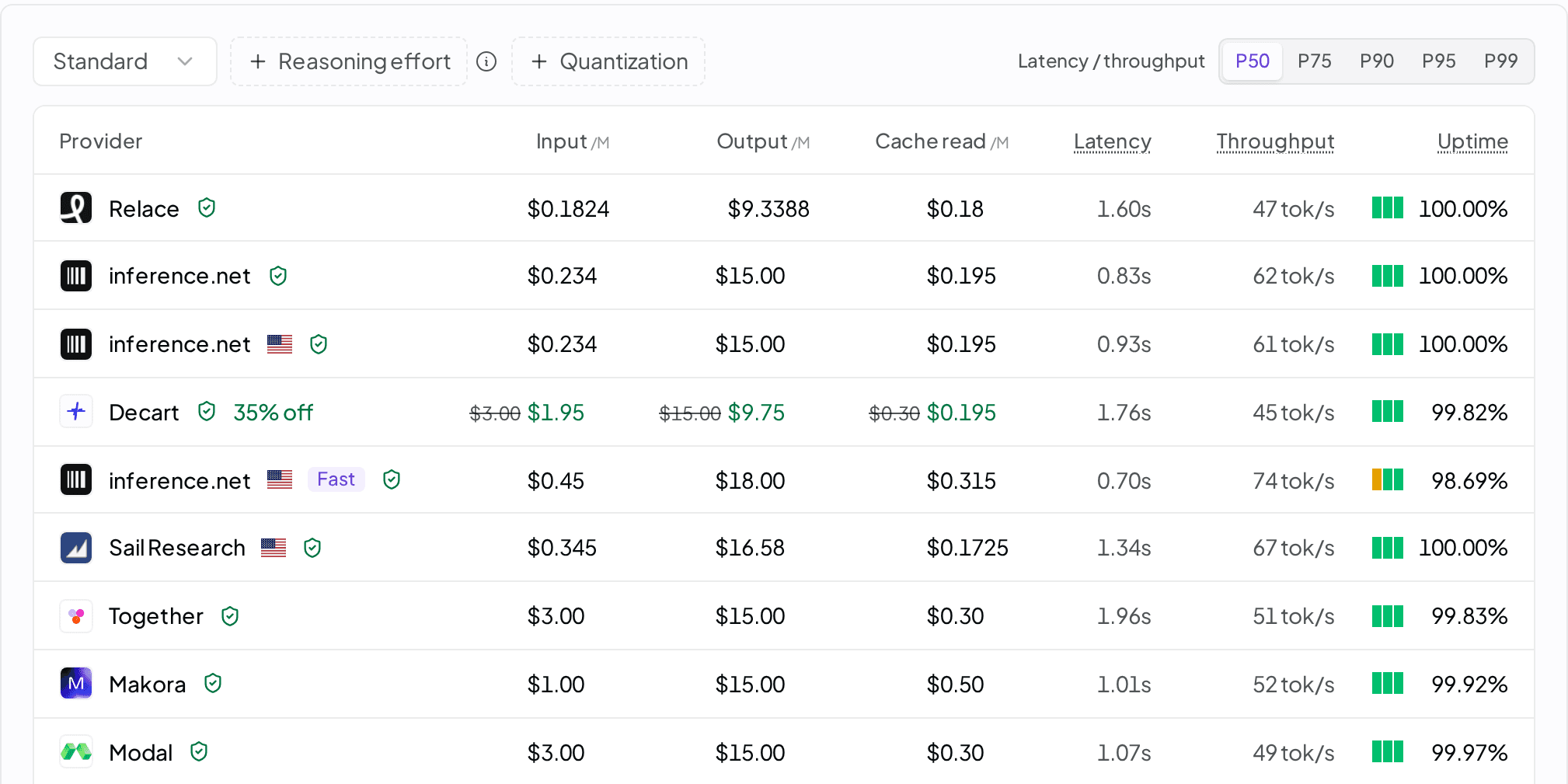
The same model can perform very differently from one provider to the next. OpenRouter shows Stu the uptime and throughput of every provider serving a model. “This actually gave me a very clear picture in terms of determining which provider I would choose,” he says.
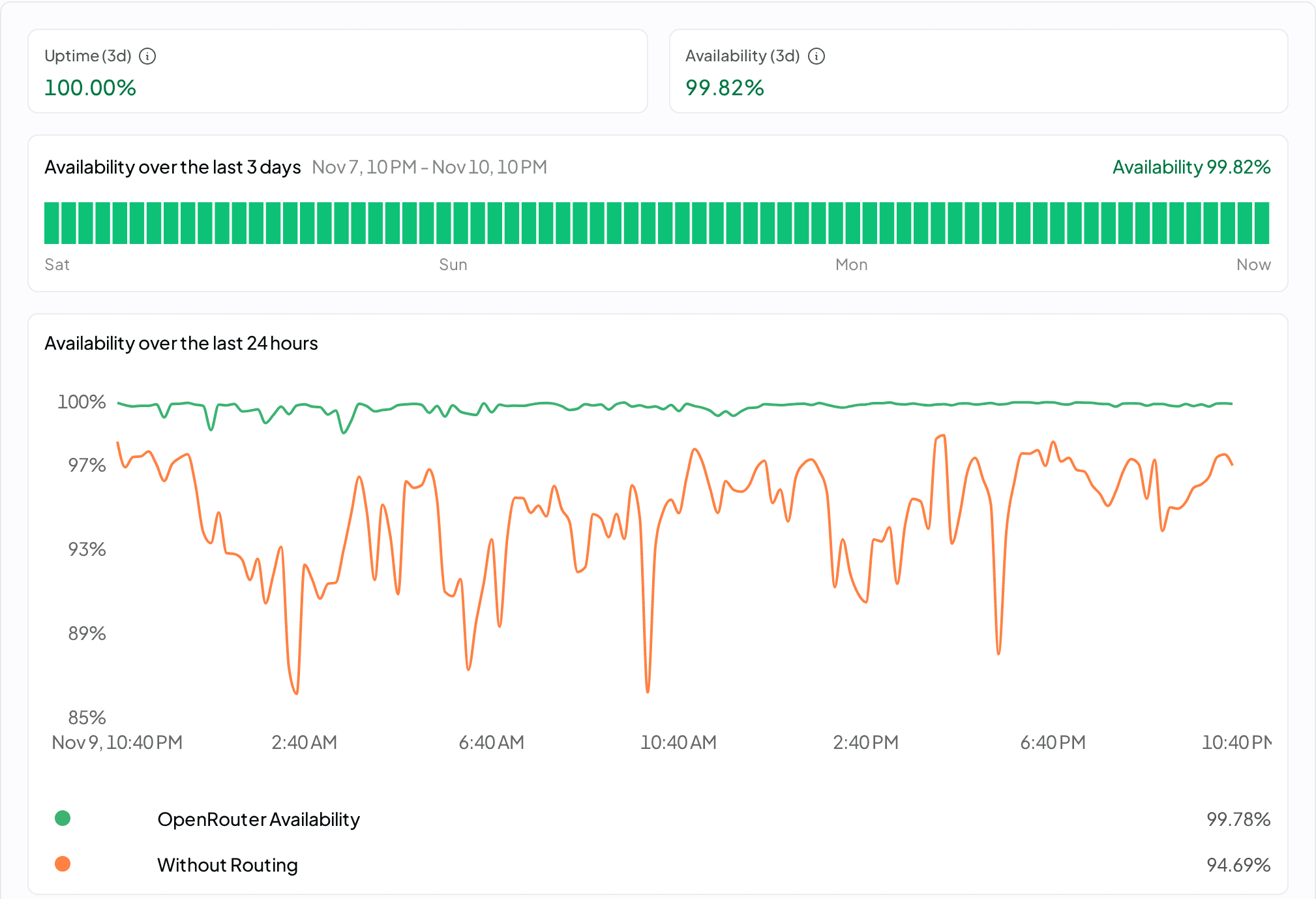
For each model, he puts the provider with the best throughput and uptime first. “If there's a failure on this provider, OpenRouter just automatically shifts to the next provider down the list,” he says. “We're still using our favorite provider and also this fallback is basically not even impacting our product.”
In one month, about 640,000 of Prime Intellect's requests failed on the first provider they tried and were completed by another. “It's a very smooth transition and we never really notice any outage on our end,” Stu says.
New models on day one
New models come through the API and authentication the team already uses. “Whenever there's a model available, we can use that model right away,” Stu says. Prime Intellect was running Kimi K3 and GLM 5.2 within a day of each model's first traffic on OpenRouter. Asked how long it takes to get to a new model, Will says, “It depends on how long it takes to type up the name.”
“The single biggest change that OpenRouter brings to Prime Intellect is velocity.”
“As a startup, we cherish the velocity,” Stu says. “That's how we can keep innovating with all the models that are coming out around the world.”
Evals are part of the daily work
Will's team measures what each model can do across workloads like agentic coding and computer use. Open models are the candidates to post-train or to generate training data. Closed models serve as baselines. “We want to understand how far are we from the frontier,” Will says.
That work depends on reaching every model at a reasonable cost. “Being able to get tokens that are fast and reliable at a good price is just essential to be able to do work around data and evals and post-training,” he says.
“The biggest thing OpenRouter has changed for us is just making doing evals in any model easy and practical,” Will says, “and the sort of thing that just becomes part of the lifecycle of doing your daily work.”
Prime Intellect as a provider
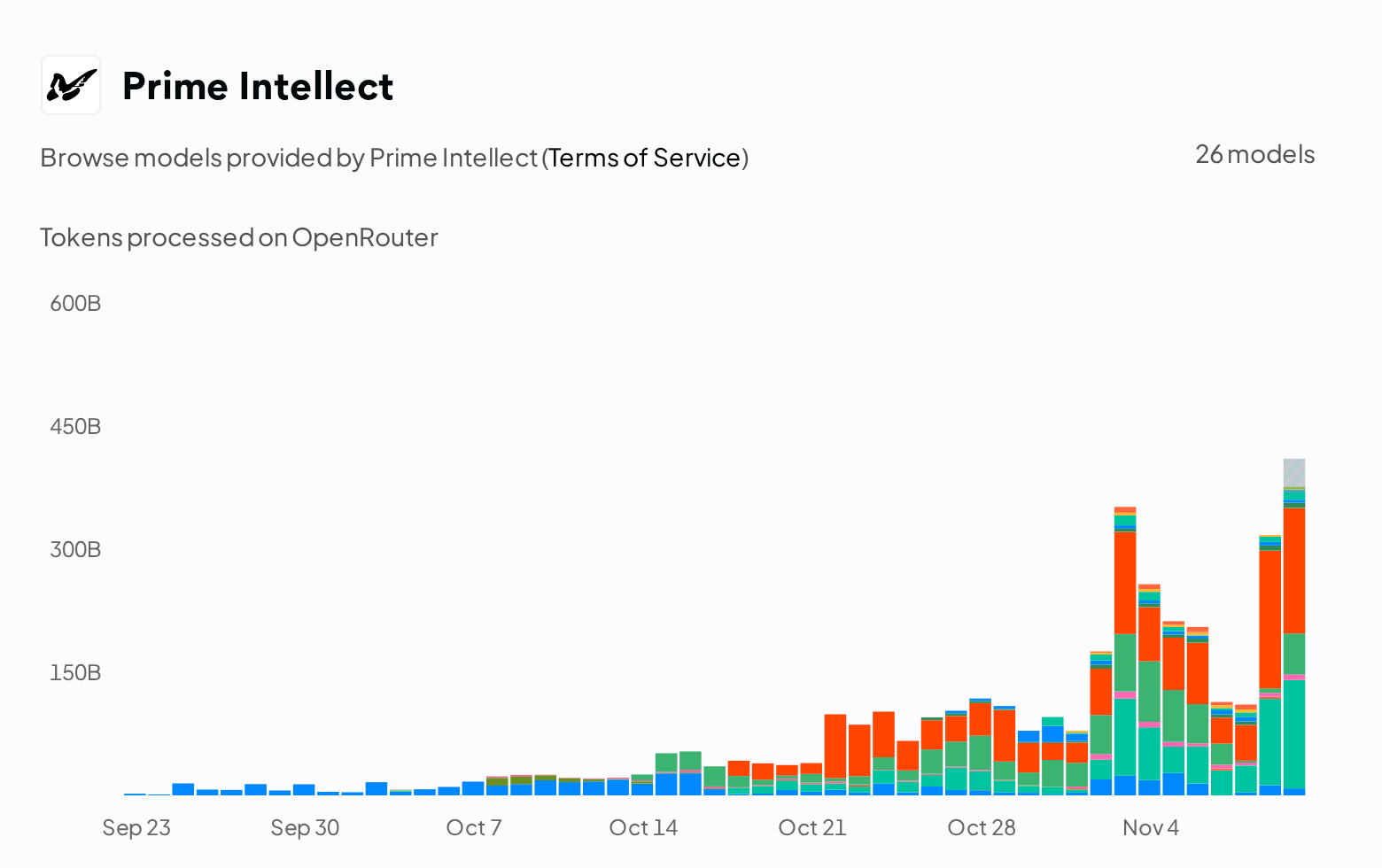
Prime Intellect also sells inference on OpenRouter, and in one week it served 11 models and ~670 billion tokens to nearly 48,000 OpenRouter accounts, with weekly token volume up ~12x over the month before. “It's a marketplace for inference,” Will says. “It's a place where we get to both be a consumer and a producer.”
That traffic shows the team how each deployment performs in production. “Am I getting good caches? Am I getting good latency? Am I handling bursts well?” Will says. What they learn goes back into training. “You train models for deployment, the deployment shapes how you train the next model,” he says.
Stu uses OpenRouter's per-model data on input lengths, reasoning and output tokens and throughput to design Prime Intellect's serving clusters. “There is no one golden inference configuration,” he says. “I can leverage that data to optimize my serving stack.”
Uptime, throughput and price are public for every provider on OpenRouter, so users can compare Prime Intellect with everyone else serving the same model. “If you see a provider that is 99.99% up and then you see another one that's only 80% up, you'll go for the one that's obviously more reliable,” Vincent says. “I think we've been able to prove how strong we are on inference also through showcasing this through OpenRouter.”
Will sees the same thing from both sides. “Whether we have capacity to host a model or whether someone else does, we can abstract this away, and OpenRouter has solved this problem,” he says.
“It means a multi-model world is already very much in reach.”
더 많은 고객 사례


Sentry
Sentry가 접근을 제한하지 않고 급증하는 AI 비용을 억제한 방법
Sentry는 내부 AI 사용을 OpenRouter로 이전하고 제공업체 키 약 500개를 폐기했으며, 모델 선택을 제한하지 않으면서 과도한 요금에 상한을 설정했습니다.
스토리 읽기Descript
Descript가 신규 모델 도입을 엔지니어링 대기열에서 제외한 방법
Descript는 단일 OpenRouter 통합으로 네 개발사의 13개 모델을 실행합니다. 신규 모델 평가 시간을 일주일에서 두어 시간으로 단축한 방법을 소개합니다.
스토리 읽기Pax Historia
대학 기숙사에서 2,000만 라운드까지: Pax Historia의 대체 역사 게임
대학 신입생 두 명이 역대 최고 수준의 이용자 유지율을 기록한 AI 게임을 만든 방법 — 일일 플레이어 3만 5천 명, 지난달에만 OpenRouter를 통해 요청 487만 건 처리.
스토리 읽기